Soumya SUBBIREDDY
Home
About
THE BIG FEED
Aligning Donor Motivation with
Impact-Driven Giving
Evaluating the effectiveness of its Giving Circle model and uncover how donor expectations aligned — or misaligned — with the BigFeed’s approach.
The Big Feed is an Australian non-profit focused on addressing food insecurity through community-driven initiatives.
To expand donor engagement, the organisation introduced a Giving Circle model, where donors contribute a fixed amount and collectively decide how funds are allocated.
However, despite strong intent, the model struggled to gain traction.
This research project investigated why donors were hesitant to engage with the Giving Circle, and identified opportunities to better align the organisation’s approach with donor expectations.
My role was to lead the UX research, synthesise insights, and develop strategic recommendations to guide future donor engagement efforts.
Role
UX Researcher
Duration
2 months
Location
Melbourne, Australia
Methods
User interviews, contextual inquiry, UX audits, journey mapping
Key Deliverables
- Donor motivation research report
- Strategic insights into the Giving Circle model
- Impact–Effort prioritisation matrix
- Actionable strategic recommendations
Impact
Challenged a core business assumption before significant investment was made.
The research revealed that resistance wasn’t about user targeting or messaging — it was about the Giving Circle model itself. By surfacing this early, the team was able to rethink its donation strategy before investing further time and resources into optimising a model that donors fundamentally did not resonate with.
Problem
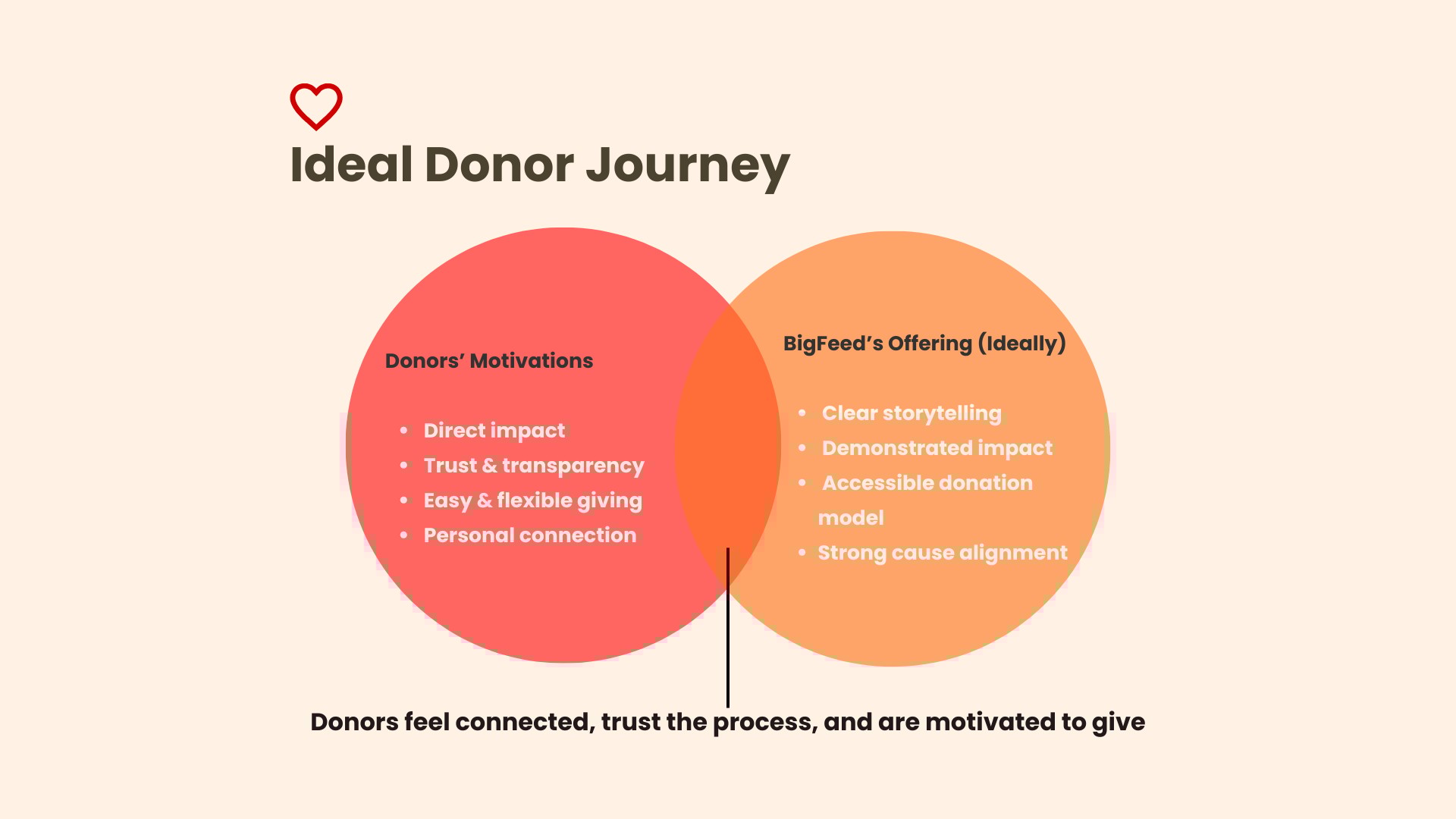
Donors believed in the cause — but not in the model.
Donors want to feel confident that their contribution will create real, visible impact.
They want transparency, flexibility, and a sense that they are supporting something genuine — not a system that feels transactional or distant.
These expectations are not unique to The Big Feed. They are fundamental to how people decide whether to give at all.
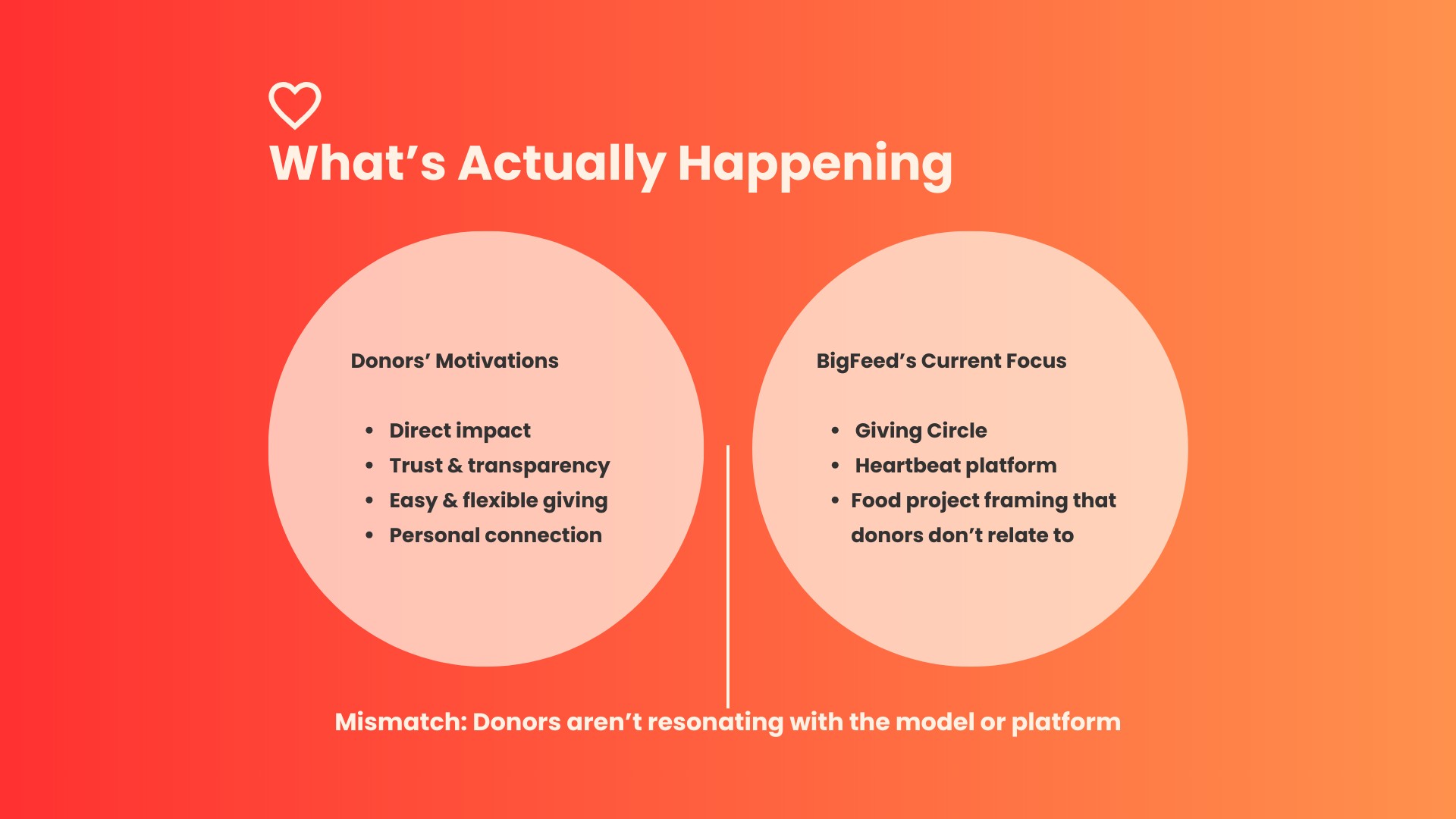
However, as I looked closely at how donors experienced The Big Feed, a gap became clear. The motivation was there — but the model, language, and framing weren’t landing.
Research Approach: Listening Before Fixing
To understand this disconnect, I used a mixed-method research approach.
I began with a stakeholder interview to understand organisational intent and constraints.
This was followed by secondary research and competitor analysis, exploring how other charities frame trust, impact, and choice.
The heart of the research came from in-depth user interviews with people across:
- age groups
- donation experience
- community involvement
- connection to food and social causes
Rather than validating assumptions, the goal was to let patterns emerge naturally.
Two Donor Mindsets
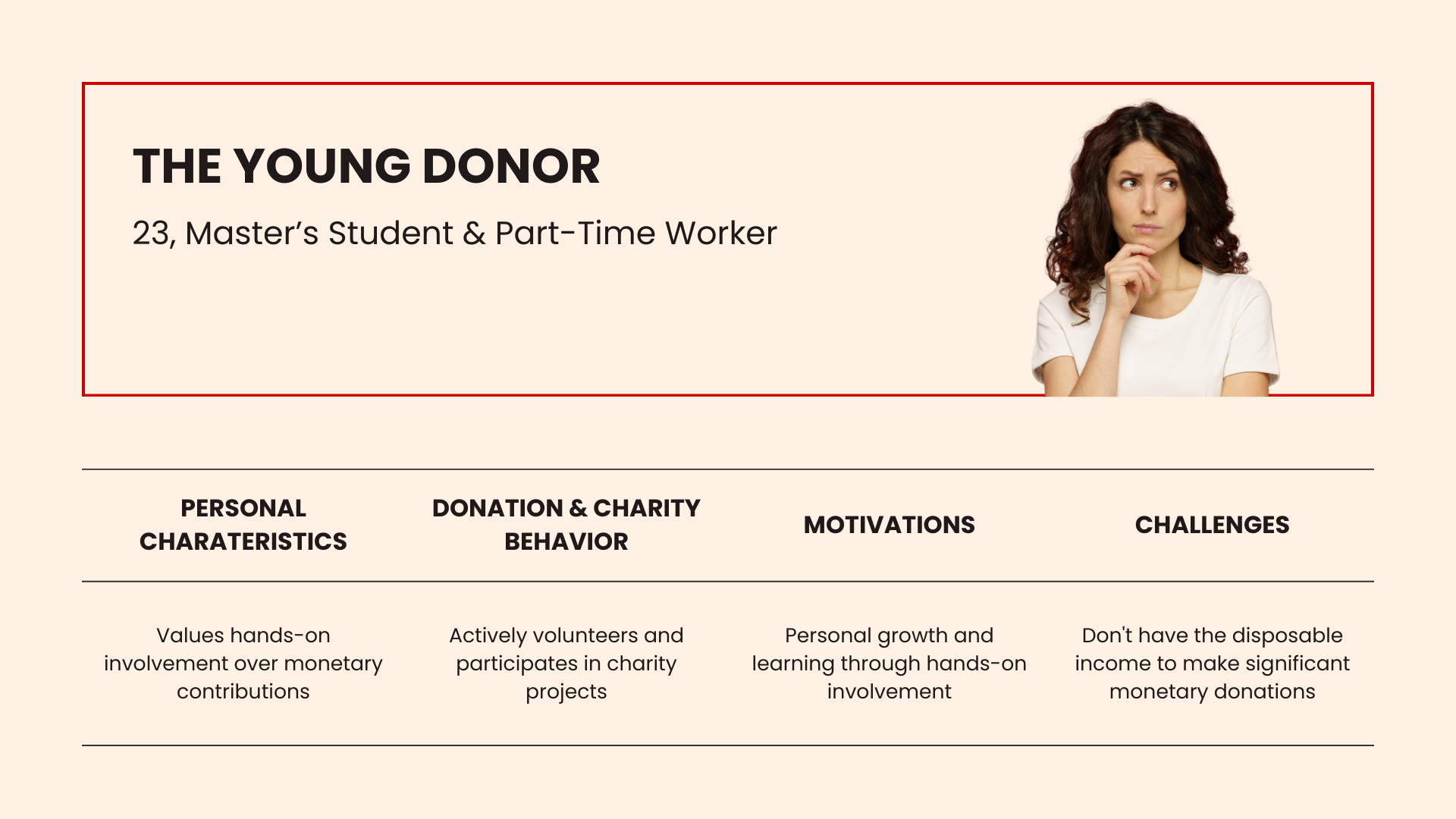
The Young Donor
Often students or early-career professionals, they valued hands-on involvement more than money.
They cared deeply — but didn’t yet have the financial freedom to give comfortably.
For them, a $50 minimum donation felt heavy, even when the cause aligned with their values.
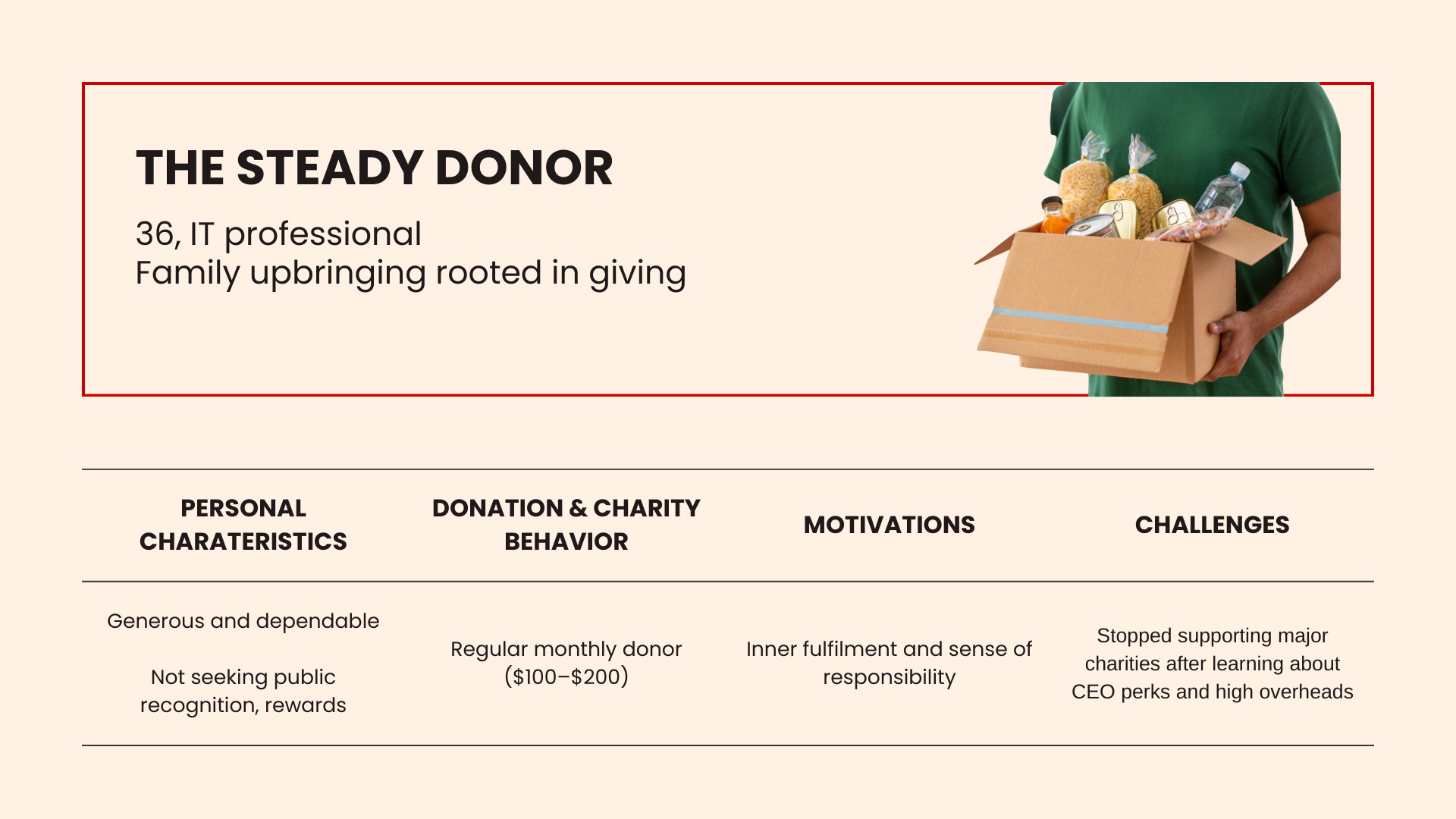
The Steady Donor
Typically in their 30s or older, these donors already gave regularly.
What stopped them wasn’t money — it was trust.
Many had disengaged from large charities after learning about overheads, leadership perks, or vague impact reporting.
These two mindsets became anchors for synthesis and decision-making.
What Donors Really Want
Across interviews, donors kept returning to the same themes:
This framed the lens through which all findings were evaluated
- they want trust, without compromise
- they want visible impact, not abstract promises
- they want flexibility, not rigid systems
- they want to feel that their contribution actually mattered
Hearing It From Donors
These excerpts capture the emotional undercurrents behind the data — the hesitation, skepticism, and expectations that shaped the research insights.
User Interview Participant
Age: 37
It’s like a sales target to group 10 people and get $500.
User Interview Participant
Age: 38
Australia is a developed country; how can food insecurity be an issue?
User Interview Participant
Age: 23
While I understand the importance of donating, for someone just starting out in their career, $50 feels like a lot to give at once.
User Interview Participant
Age: 23
We are more about the root-cause, solving the original problem and not solving short temperory problem.




Insight 1: The Giving Circle Felt Transactional
When donors encountered the Giving Circle, many described it as feeling more like a target than a collective act of giving.
Even though the voting system was designed to feel democratic, it had the opposite effect — creating frustration and loss of control.
The idea of “grouping people to reach a dollar amount” unintentionally stripped the emotional meaning from the act of donating.

Research insight:
Democracy without emotional ownership doesn’t feel empowering — it feels transactional.

Recommendation:
Rethink or remove the Giving Circle voting model, and introduce alternative ways to give that restore personal agency.
Insight 2: Food Insecurity in Australia Didn’t Feel Real
Several participants questioned whether food insecurity was even a real issue in Australia.
This wasn’t disbelief — it was distance.
Without visibility into real lives and systemic causes, the issue felt abstract and disconnected from their reality.
Research insight:
People don’t distrust the cause — they lack context.
Recommendation:
Shift storytelling from what The Big Feed does to why food insecurity exists, using real people, real stories, and lived experiences.
Insight 3: Trust Breakers: Visuals Matter More Than We Think
One of the strongest emotional reactions came from visuals.
AI-generated images immediately reduced credibility.
Participants described them as “marketing-like” and “inauthentic.”
Research insight:
In non-profits, authenticity isn’t aesthetic — it’s trust.
Recommendation:
Use real photography and real stories, even if imperfect.
Insight 4: Who Should The Big Feed Focus On?
The research made one thing clear:
Steady donors are the financial backbone.
Younger donors are the future.
Trying to serve both with the same model diluted impact.
Recommendation:
- Prioritise steady donors (30+) for sustainable funding
- Nurture younger donors through volunteering, flexible donation tiers, and long-term engagement paths
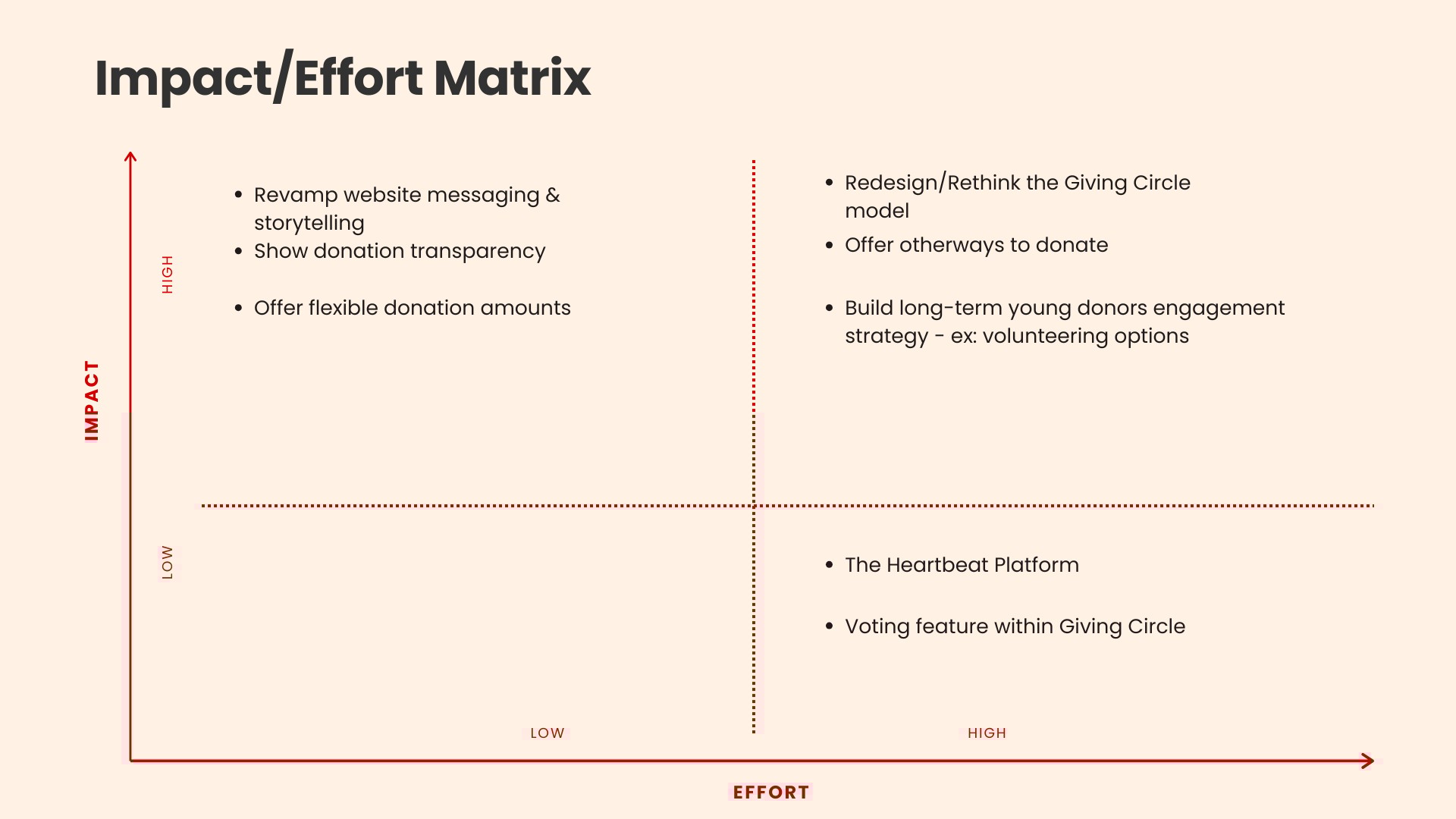
From Insights to Strategy
Mapping insights against effort and impact helped surface where The Big Feed should focus first.
High-impact opportunities included:
- improving transparency
- revamping storytelling
- offering flexible donation options
- rethinking the Giving Circle
Lower-priority initiatives could follow once trust was rebuilt.
What Changed Because of This Research
The research helped the organisation reconsider key assumptions about donor engagement, highlighting the importance of trust, storytelling, and flexible giving models.
Rather than optimising the existing model, the team was able to rethink their approach before investing further resources.
Retrospective
Strong research doesn’t just validate ideas; it enables stakeholders to reconsider long-held assumptions
This project highlighted the responsibility that comes with making strategic recommendations. When suggesting changes that affect core business models, confidence must come from evidence, not intuition.
Framing matters as much as findings
I learned that how insights are presented can significantly influence how they are received. Bold recommendations require careful framing — not dilution, but clarity, empathy, and alignment with stakeholder concerns.
“Soumya’s presentation was visually strong, well-paced, and effectively communicated sensitive insights about the Giving Circle concept. She demonstrated a thoughtful, opinionated approach backed by research, handled stakeholder dynamics gracefully, and asked strong, relevant questions — all of which impressed the team and validated her recommendations.”
Kay, Founder, The Big Feed
Soumya SUBBIREDDY
Home
About
THE BIG FEED
Aligning Donor Motivation with
Impact-Driven Giving
Evaluating the effectiveness of its Giving Circle model and uncover how donor expectations aligned — or misaligned — with the BigFeed’s approach.
The Big Feed is an Australian non-profit focused on addressing food insecurity through community-driven initiatives.
To expand donor engagement, the organisation introduced a Giving Circle model, where donors contribute a fixed amount and collectively decide how funds are allocated.
However, despite strong intent, the model struggled to gain traction.
This research project investigated why donors were hesitant to engage with the Giving Circle, and identified opportunities to better align the organisation’s approach with donor expectations.
My role was to lead the UX research, synthesise insights, and develop strategic recommendations to guide future donor engagement efforts.
Role
UX Researcher
Duration
2 months
Location
Melbourne, Australia
Methods
User interviews, contextual inquiry, UX audits, journey mapping
Key Deliverables
- Donor motivation research report
- Strategic insights into the Giving Circle model
- Impact–Effort prioritisation matrix
- Actionable strategic recommendations
Impact
Challenged a core business assumption before significant investment was made.
The research revealed that resistance wasn’t about user targeting or messaging — it was about the Giving Circle model itself. By surfacing this early, the team was able to rethink its donation strategy before investing further time and resources into optimising a model that donors fundamentally did not resonate with.
Problem
Donors believed in the cause — but not in the model.
Donors want to feel confident that their contribution will create real, visible impact.
They want transparency, flexibility, and a sense that they are supporting something genuine — not a system that feels transactional or distant.
These expectations are not unique to The Big Feed. They are fundamental to how people decide whether to give at all.
However, as I looked closely at how donors experienced The Big Feed, a gap became clear. The motivation was there — but the model, language, and framing weren’t landing.
Research Approach: Listening Before Fixing
To understand this disconnect, I used a mixed-method research approach.
I began with a stakeholder interview to understand organisational intent and constraints.
This was followed by secondary research and competitor analysis, exploring how other charities frame trust, impact, and choice.
The heart of the research came from in-depth user interviews with people across:
- age groups
- donation experience
- community involvement
- connection to food and social causes
Rather than validating assumptions, the goal was to let patterns emerge naturally.
Two Donor Mindsets
The Young Donor
Often students or early-career professionals, they valued hands-on involvement more than money.
They cared deeply — but didn’t yet have the financial freedom to give comfortably.
For them, a $50 minimum donation felt heavy, even when the cause aligned with their values.
The Steady Donor
Typically in their 30s or older, these donors already gave regularly.
What stopped them wasn’t money — it was trust.
Many had disengaged from large charities after learning about overheads, leadership perks, or vague impact reporting.
These two mindsets became anchors for synthesis and decision-making.
What Donors Really Want
Across interviews, donors kept returning to the same themes:
This framed the lens through which all findings were evaluated
- they want trust, without compromise
- they want visible impact, not abstract promises
- they want flexibility, not rigid systems
- they want to feel that their contribution actually mattered
Hearing It From Donors
These excerpts capture the emotional undercurrents behind the data — the hesitation, skepticism, and expectations that shaped the research insights.
User Interview Participant
Age: 37
It’s like a sales target to group 10 people and get $500.
User Interview Participant
Age: 38
Australia is a developed country; how can food insecurity be an issue?
User Interview Participant
Age: 23
While I understand the importance of donating, for someone just starting out in their career, $50 feels like a lot to give at once.
User Interview Participant
Age: 23
We are more about the root-cause, solving the original problem and not solving short temperory problem.
Insight 1: The Giving Circle Felt Transactional
When donors encountered the Giving Circle, many described it as feeling more like a target than a collective act of giving.
Even though the voting system was designed to feel democratic, it had the opposite effect — creating frustration and loss of control.
The idea of “grouping people to reach a dollar amount” unintentionally stripped the emotional meaning from the act of donating.
Research insight:
Democracy without emotional ownership doesn’t feel empowering — it feels transactional.
Recommendation:
Rethink or remove the Giving Circle voting model, and introduce alternative ways to give that restore personal agency.
Insight 2: Food Insecurity in Australia Didn’t Feel Real
Several participants questioned whether food insecurity was even a real issue in Australia.
This wasn’t disbelief — it was distance.
Without visibility into real lives and systemic causes, the issue felt abstract and disconnected from their reality.
Research insight:
People don’t distrust the cause — they lack context.
Recommendation:
Shift storytelling from what The Big Feed does to why food insecurity exists, using real people, real stories, and lived experiences.
Insight 3: Trust Breakers: Visuals Matter More Than We Think
One of the strongest emotional reactions came from visuals.
AI-generated images immediately reduced credibility.
Participants described them as “marketing-like” and “inauthentic.”
Research insight:
In non-profits, authenticity isn’t aesthetic — it’s trust.
Recommendation:
Use real photography and real stories, even if imperfect.
Insight 4: Who Should The Big Feed Focus On?
The research made one thing clear:
Steady donors are the financial backbone.
Younger donors are the future.
Trying to serve both with the same model diluted impact.
Recommendation:
- Prioritise steady donors (30+) for sustainable funding
- Nurture younger donors through volunteering, flexible donation tiers, and long-term engagement paths
From Insights to Strategy
Mapping insights against effort and impact helped surface where The Big Feed should focus first.
High-impact opportunities included:
- improving transparency
- revamping storytelling
- offering flexible donation options
- rethinking the Giving Circle
Lower-priority initiatives could follow once trust was rebuilt.
What Changed Because of This Research
The research helped the organisation reconsider key assumptions about donor engagement, highlighting the importance of trust, storytelling, and flexible giving models.
Rather than optimising the existing model, the team was able to rethink their approach before investing further resources.
Retrospective
Strong research doesn’t just validate ideas; it enables stakeholders to reconsider long-held assumptions
This project highlighted the responsibility that comes with making strategic recommendations. When suggesting changes that affect core business models, confidence must come from evidence, not intuition.
Framing matters as much as findings
I learned that how insights are presented can significantly influence how they are received. Bold recommendations require careful framing — not dilution, but clarity, empathy, and alignment with stakeholder concerns.
“Soumya’s presentation was visually strong, well-paced, and effectively communicated sensitive insights about the Giving Circle concept. She demonstrated a thoughtful, opinionated approach backed by research, handled stakeholder dynamics gracefully, and asked strong, relevant questions — all of which impressed the team and validated her recommendations.”
Kay, Founder, The Big Feed
Soumya SUBBIREDDY
Home
About
THE BIG FEED
Aligning Donor Motivation with
Impact-Driven Giving
Evaluating the effectiveness of its Giving Circle model and uncover how donor expectations aligned — or misaligned — with the BigFeed’s approach.
The Big Feed is an Australian non-profit focused on addressing food insecurity through community-driven initiatives.
To expand donor engagement, the organisation introduced a Giving Circle model, where donors contribute a fixed amount and collectively decide how funds are allocated.
However, despite strong intent, the model struggled to gain traction.
This research project investigated why donors were hesitant to engage with the Giving Circle, and identified opportunities to better align the organisation’s approach with donor expectations.
My role was to lead the UX research, synthesise insights, and develop strategic recommendations to guide future donor engagement efforts.
Role
UX Researcher
Duration
2 months
Location
Melbourne, Australia
Methods
User interviews, contextual inquiry, UX audits, journey mapping
Key Deliverables
- Donor motivation research report
- Strategic insights into the Giving Circle model
- Impact–Effort prioritisation matrix
- Actionable strategic recommendations
Impact
Challenged a core business assumption before significant investment was made.
The research revealed that resistance wasn’t about user targeting or messaging — it was about the Giving Circle model itself. By surfacing this early, the team was able to rethink its donation strategy before investing further time and resources into optimising a model that donors fundamentally did not resonate with.
Problem
Donors believed in the cause — but not in the model.
Donors want to feel confident that their contribution will create real, visible impact.
They want transparency, flexibility, and a sense that they are supporting something genuine — not a system that feels transactional or distant.
These expectations are not unique to The Big Feed. They are fundamental to how people decide whether to give at all.
However, as I looked closely at how donors experienced The Big Feed, a gap became clear. The motivation was there — but the model, language, and framing weren’t landing.
Research Approach: Listening Before Fixing
To understand this disconnect, I used a mixed-method research approach.
I began with a stakeholder interview to understand organisational intent and constraints.
This was followed by secondary research and competitor analysis, exploring how other charities frame trust, impact, and choice.
The heart of the research came from in-depth user interviews with people across:
- age groups
- donation experience
- community involvement
- connection to food and social causes
Rather than validating assumptions, the goal was to let patterns emerge naturally.
Two Donor Mindsets
The Young Donor
Often students or early-career professionals, they valued hands-on involvement more than money.
They cared deeply — but didn’t yet have the financial freedom to give comfortably.
For them, a $50 minimum donation felt heavy, even when the cause aligned with their values.
The Steady Donor
Typically in their 30s or older, these donors already gave regularly.
What stopped them wasn’t money — it was trust.
Many had disengaged from large charities after learning about overheads, leadership perks, or vague impact reporting.
These two mindsets became anchors for synthesis and decision-making.
What Donors Really Want
Across interviews, donors kept returning to the same themes:
This framed the lens through which all findings were evaluated
- they want trust, without compromise
- they want visible impact, not abstract promises
- they want flexibility, not rigid systems
- they want to feel that their contribution actually mattered
Hearing It From Donors
These excerpts capture the emotional undercurrents behind the data — the hesitation, scepticism, and expectations that shaped the research insights.
User Interview Participant
Age: 37
It’s like a sales target to group 10 people and get $500.
User Interview Participant
Age: 38
Australia is a developed country; how can food insecurity be an issue?
User Interview Participant
Age: 23
While I understand the importance of donating, for someone just starting out in their career, $50 feels like a lot to give at once.
User Interview Participant
Age: 23
We are more about the root-cause, solving the original problem and not solving short temporary problem.
Insight 1: The Giving Circle Felt Transactional
When donors encountered the Giving Circle, many described it as feeling more like a target than a collective act of giving.
Even though the voting system was designed to feel democratic, it had the opposite effect — creating frustration and loss of control.
The idea of “grouping people to reach a dollar amount” unintentionally stripped the emotional meaning from the act of donating.
Research insight:
Democracy without emotional ownership doesn’t feel empowering — it feels transactional.
Recommendation:
Rethink or remove the Giving Circle voting model, and introduce alternative ways to give that restore personal agency.
Insight 2: Food Insecurity in Australia Didn’t Feel Real
Several participants questioned whether food insecurity was even a real issue in Australia.
This wasn’t disbelief — it was distance.
Without visibility into real lives and systemic causes, the issue felt abstract and disconnected from their reality.
Research insight:
People don’t distrust the cause — they lack context.
Recommendation:
Shift storytelling from what The Big Feed does to why food insecurity exists, using real people, real stories, and lived experiences.
Insight 3: Trust Breakers: Visuals Matter More Than We Think
One of the strongest emotional reactions came from visuals.
AI-generated images immediately reduced credibility.
Participants described them as “marketing-like” and “inauthentic.”
Research insight:
In non-profits, authenticity isn’t aesthetic — it’s trust.
Recommendation:
Use real photography and real stories, even if imperfect.
Insight 4: Who Should The Big Feed Focus On?
The research made one thing clear:
Steady donors are the financial backbone.
Younger donors are the future.
Trying to serve both with the same model diluted impact.
Recommendation:
- Prioritise steady donors (30+) for sustainable funding
- Nurture younger donors through volunteering, flexible donation tiers, and long-term engagement paths
From Insights to Strategy
Mapping insights against effort and impact helped surface where The Big Feed should focus first.
High-impact opportunities included:
- improving transparency
- revamping storytelling
- offering flexible donation options
- rethinking the Giving Circle
Lower-priority initiatives could follow once trust was rebuilt.
What Changed Because of This Research
The research helped the organisation reconsider key assumptions about donor engagement, highlighting the importance of trust, storytelling, and flexible giving models.
Rather than optimising the existing model, the team was able to rethink their approach before investing further resources.
Retrospective
Strong research doesn’t just validate ideas; it enables stakeholders to reconsider long-held assumptions
This project highlighted the responsibility that comes with making strategic recommendations. When suggesting changes that affect core business models, confidence must come from evidence, not intuition.
Framing matters as much as findings
I learned that how insights are presented can significantly influence how they are received. Bold recommendations require careful framing — not dilution, but clarity, empathy, and alignment with stakeholder concerns.
“Soumya’s presentation was visually strong, well-paced, and effectively communicated sensitive insights about the Giving Circle concept. She demonstrated a thoughtful, opinionated approach backed by research, handled stakeholder dynamics gracefully, and asked strong, relevant questions — all of which impressed the team and validated her recommendations.”
Kay, Founder, The Big Feed